
Puget Sound Sailing History | Port Townsend vs. Seattle
Before Seattle became the city everyone associates with Puget Sound, another town seemed destined for that role. Puget Sound sailing history has a habit of turning on small, practical details rather than grand ambition, and few stories make that clearer than the rivalry between Seattle and a small waterfront city at the Sound’s northern entrance: Port Townsend.
By the 1860s, boosters were calling it the “Key City” and the “New York of the West.” It had the deep water, the harbor, and for decades, the law on its side. Every ship arriving from a foreign port was required to stop there before sailing on to Seattle or anywhere else on the Sound.
What actually decided the rivalry wasn’t ambition or investment capital. It was a change in how ships crossed the water in the first place, and Port Townsend was standing on the wrong side of it.
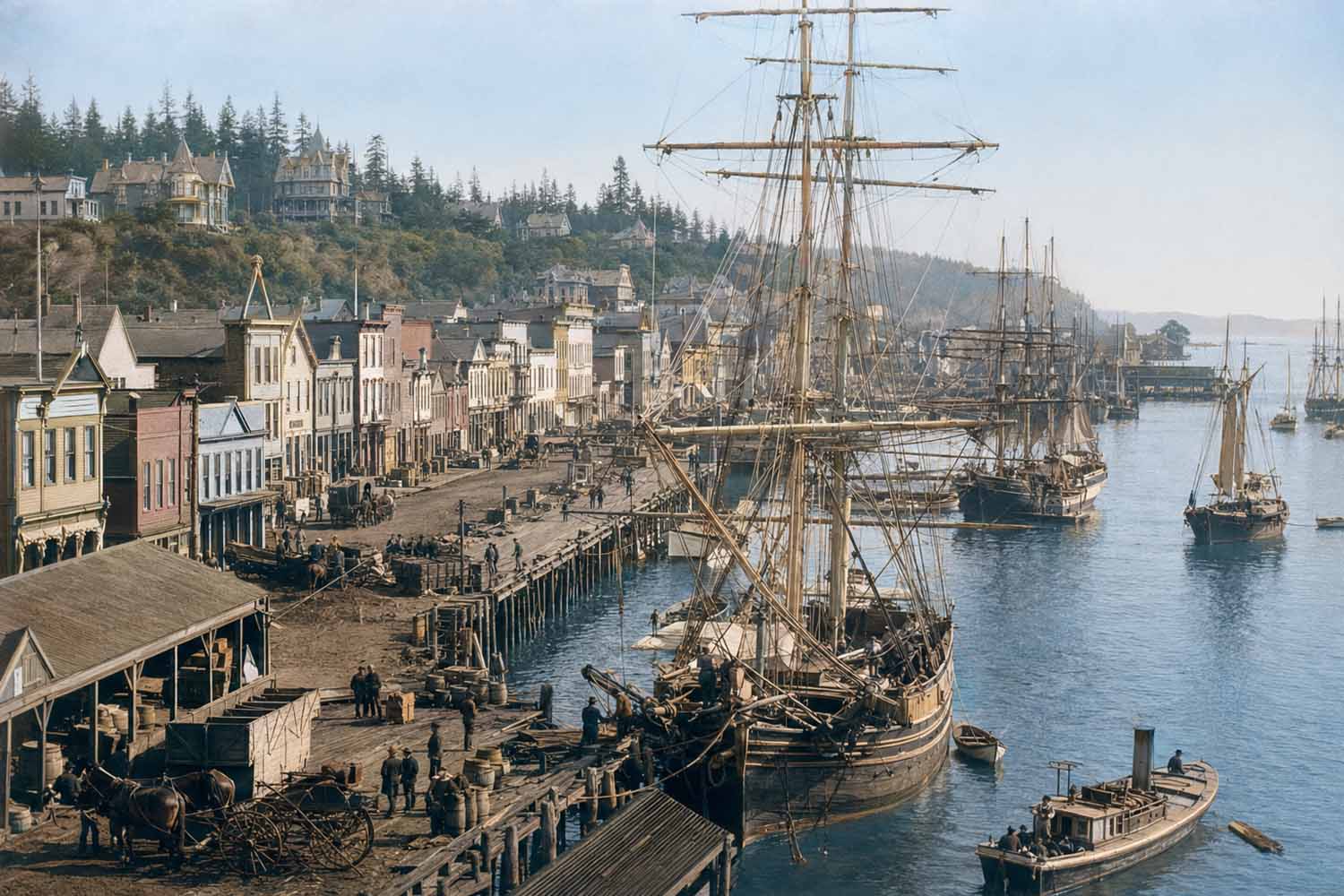
The Town Every Ship Had to Visit
In 1854, the headquarters of the Puget Sound Customs Collection District moved to Port Townsend from Olympia. From that point on, every vessel arriving from a foreign port was legally required to stop there and clear customs before continuing down-sound. Domestic ships often stopped too, simply because it sat right at the entrance to the Sound, the first safe harbor a sailing vessel would reach after a long ocean crossing.
That single legal requirement built an entire economy. Chandleries stocked ship supplies of every description. A cracker factory turned out hardtack for outbound crews. Hotels, saloons, and boardinghouses filled with sailors passing through, and by some estimates, half the ships entering Puget Sound picked up crew members in Port Townsend before heading on.
By 1860, the town’s population had made it the seventh-largest settlement in the territory, respectable for a place with only a few hundred residents a decade earlier. Optimistic boosters started calling it the “Key City” of Puget Sound, certain that its position at the gateway would only grow more valuable as the region filled in behind it.
For a sailing-era economy built around wind, tides, and a mandatory stop at the Sound’s front door, that confidence made complete sense.
A City Built on Promises
The one thing Port Townsend never secured was a railroad, and its citizens spent nearly forty years trying. James G. Swan, a local booster and one-time Northern Pacific agent, pushed hard for the town to be chosen as the railroad’s western terminus. In 1873, the company chose Tacoma instead.
The dream refused to die. In 1887, local investors incorporated their own line, the Port Townsend & Southern Railroad, and began laying track south toward Olympia. The money ran out after a single mile.
Then, in 1889, came the offer that seemed to change everything. The Union Pacific proposed making Port Townsend the northern terminus of its transcontinental line, on the condition that the city raise $100,000 and hand over the local company’s rights of way. The town raised the money almost overnight. Real estate sales alone totaled nearly $4.6 million the following year, in a city of barely 4,500 people. Banks, hotels, and a grand new city hall went up in anticipation.
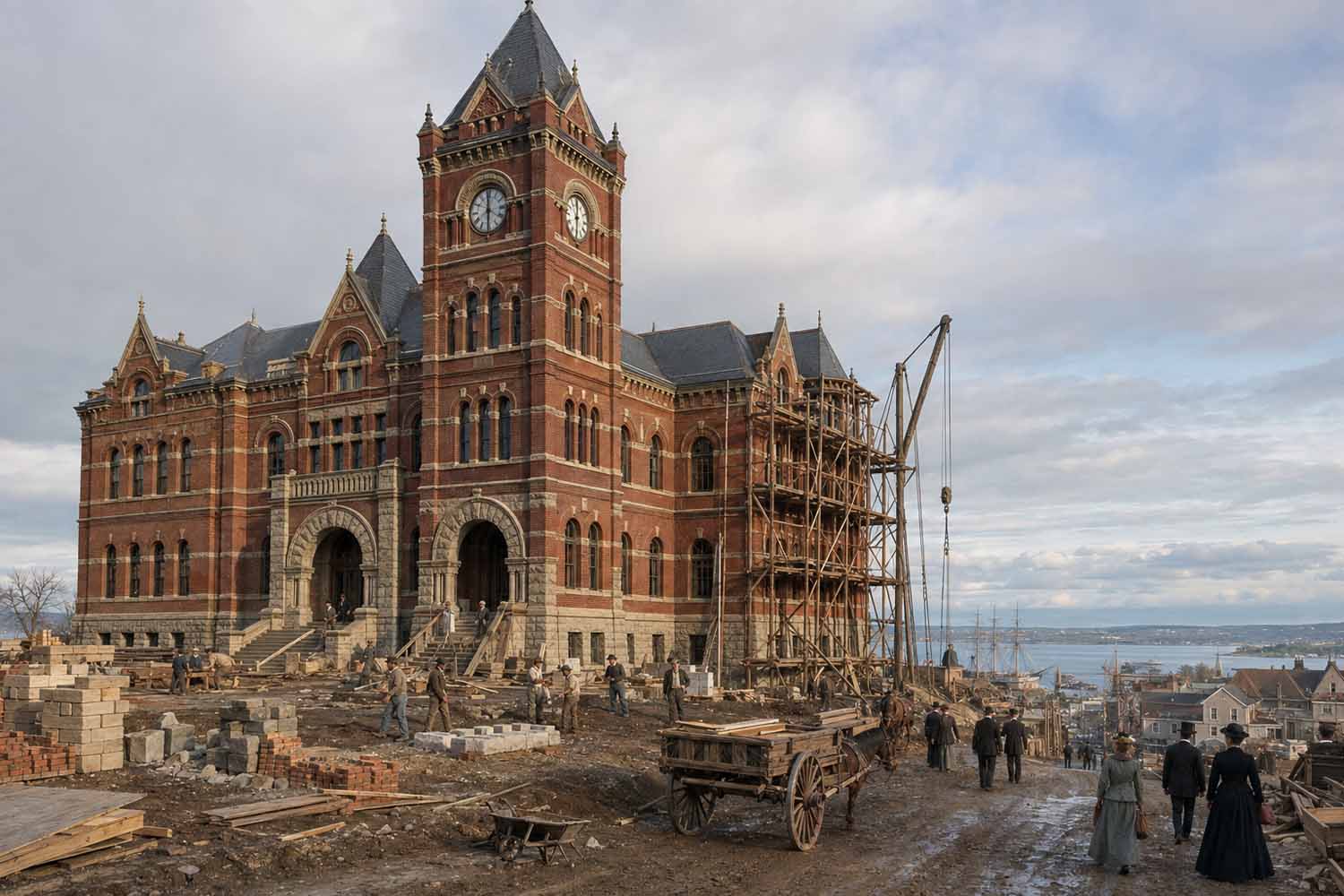
Not everyone was swept up in the optimism. A report prepared that same year for a competing railway assessed the town’s prospects bluntly, concluding that its location left it, in the report’s own words, out of the general competition. Almost no one in Port Townsend was listening.
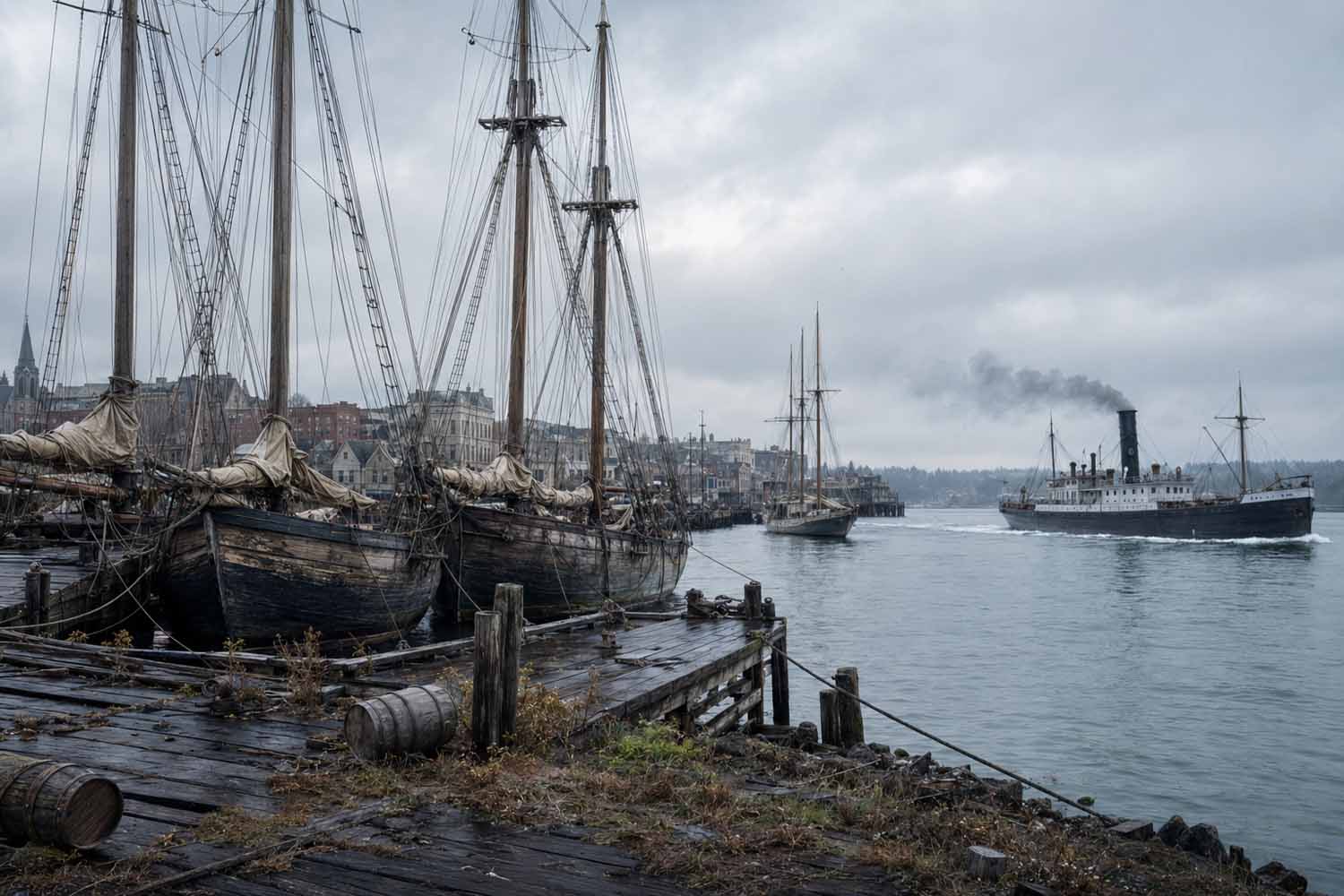
When Steam Changed Everything
Underneath the railroad drama, a quieter and more decisive shift was already underway. Through the 1870s and 80s, steam power increasingly replaced sail on Puget Sound, and the Sound’s shifting inland winds, the very thing that had made a sheltered stopping point near the entrance so valuable, became largely irrelevant to navigation. A steamship didn’t need to time its arrival around the wind. If it didn’t legally have to stop at Port Townsend for customs, it often didn’t stop there at all.
The railroad collapse arrived right on top of that. South of town, the company building toward Olympia went bankrupt in late 1890. To the north, construction crews ran the line straight into the base of Mount Walker near Quilcene and found no practical way around it. Then came the Panic of 1893, a national financial collapse fueled in part by exactly the kind of railroad overbuilding Port Townsend had gambled on.
Commerce in the harbor slowed to a stop. Idle ships sat rotting at anchor. Property values collapsed, buildings emptied out, and nearly a quarter of the population left town within the decade. Between 1880 and 1890, Port Townsend’s population had grown by roughly 400 percent, which sounds impressive until measured against the same decade in Seattle, which grew by more than 1,100 percent.
Two Different Legacies on the Same Sound
Seattle absorbed the growth that Port Townsend had spent decades expecting. By 1911, even the Customs District headquarters, the role that had built Port Townsend’s economy in the first place, had relocated to Seattle for good.
Port Townsend’s second act took much longer to arrive, and looked nothing like its first. A paper mill opened in 1927, finally giving the city a stable, if modest, economic base. For decades afterward it remained a quiet town, largely bypassed by the growth reshaping the rest of the region.
That very stagnation turned out to be its unexpected inheritance. With little money for redevelopment, Port Townsend’s Victorian downtown and grand, half-finished-dream architecture simply stayed standing while other cities tore theirs down. Beginning in the 1960s and 70s, that preserved streetscape became a source of civic pride and, eventually, tourism.
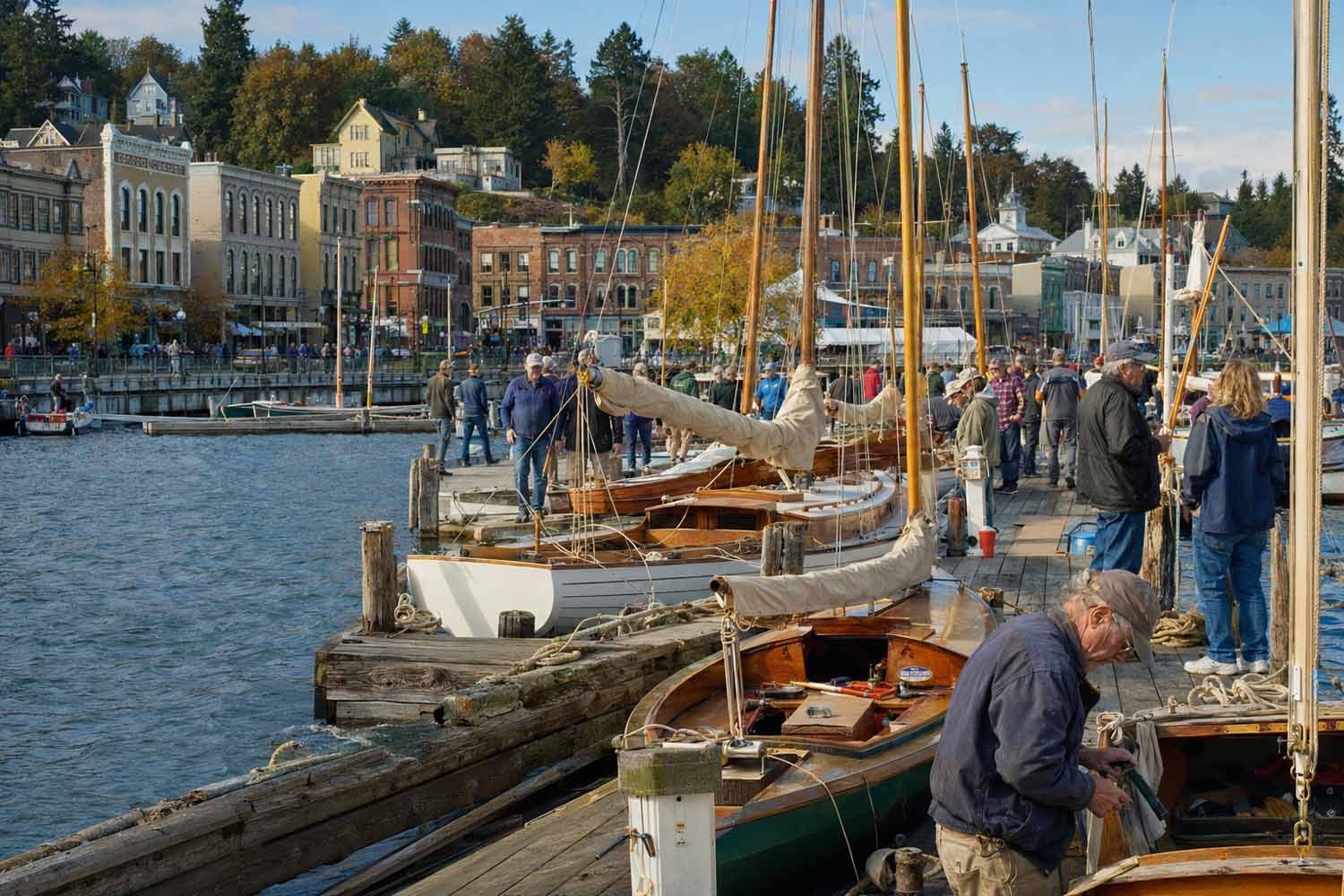
Today Port Townsend is known less for commerce than for craft: a working wooden boatbuilding culture, an annual wooden boat festival, and a maritime identity closer to the age of sail than almost anywhere else on the Sound.
Puget Sound sailing history rarely turns on a single dramatic event. More often, it turns on something as ordinary as which technology a harbor happened to be built for. Port Townsend was built for the age of sail, and when that age ended, so did its shot at becoming the region’s great port. Seattle absorbed the growth. Port Townsend, almost by accident, kept something closer to the water’s original relationship with wind and canvas.
That relationship is still out there to experience, just a short sail from Seattle’s own downtown waterfront. Aboard Seattle’s Tall Ship’s schooner Bay Lady, the engine shuts off soon after leaving the dock, and the wind alone carries you across Elliott Bay. It’s the same basic technology that once decided which towns on this Sound would rise and which would wait.