
What Is a Schooner? The Ship That Helped Build Seattle
When the founders of Seattle stepped ashore at Alki Point in November 1851, they arrived on a schooner. So what is a schooner, and how did it come to carry the founders of a city, the catch of New England’s fishing fleets, and the lumber that built the West Coast? The answer starts with a problem colonial sailors needed to solve.
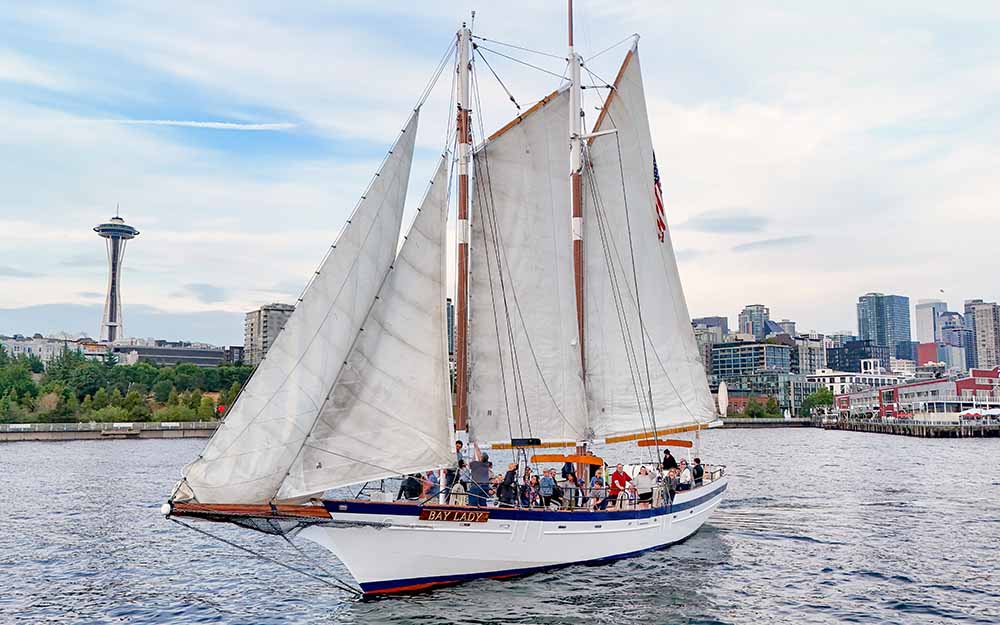
In simple terms, a schooner is a sailing ship with two or more masts and fore-and-aft sails, meaning the sails run lengthwise from bow to stern instead of hanging crosswise like the square sails of an old warship. Its front mast is the same height as, or shorter than, the masts behind it. Many traditional schooners are gaff-rigged, with four-sided sails hung from an angled spar called a gaff, which gives them their classic silhouette.
That simple arrangement became one of the most successful designs in American history. Over two centuries, schooners fished the Grand Banks, won the first America’s Cup, grew to seven masts, and sailed into Puget Sound to help build Seattle.
A Ship Built to Solve a Problem
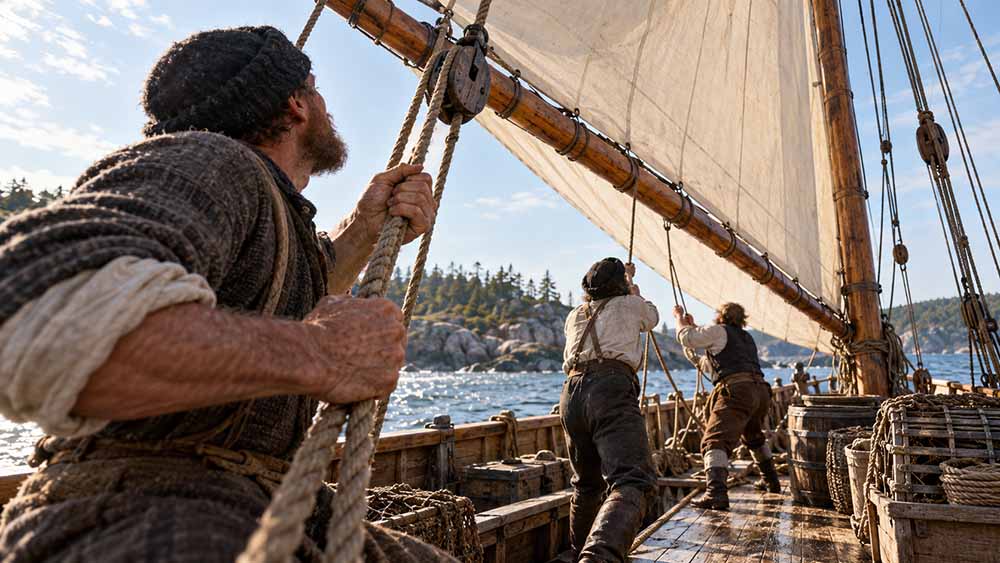
Colonial New England lived by the sea. Its towns fished the offshore banks and traded along the coast and down to the West Indies, often in small, locally built boats. The big square-rigged ships of the era were designed for long ocean crossings with steady winds behind them. Close to shore, where the wind shifted constantly and harbors were tight, they were clumsy, and handling their sails took a large crew.
The schooner solved both problems. Fore-and-aft sails can be angled to work against the wind, so a schooner could zigzag upwind into a harbor or through a shifting coastal breeze where a square-rigger would struggle. Those sails could also be raised, lowered, and trimmed from the deck by a handful of sailors, and spreading the canvas across two masts kept each sail a manageable size. For owners whose profits depended on fish and freight, a fast ship that needed a small crew was hard to beat.
The schooner even has its own origin story. As the legend goes, when shipbuilder Andrew Robinson launched a new vessel at Gloucester, Massachusetts, around 1713, a spectator cried out, “Oh, how she scoons!” Scoon was a Scots word for skipping a stone across water, and Robinson supposedly replied, “A schooner let her be.”
Historians are skeptical, since the story was written down decades later and similar rigs had already appeared in Dutch and English waters. But the colonists took the idea further than anyone. The first true schooner most likely took shape in Britain’s North American colonies, very possibly in Gloucester, and within a century it was everywhere.
The Workhorse of a Young Nation
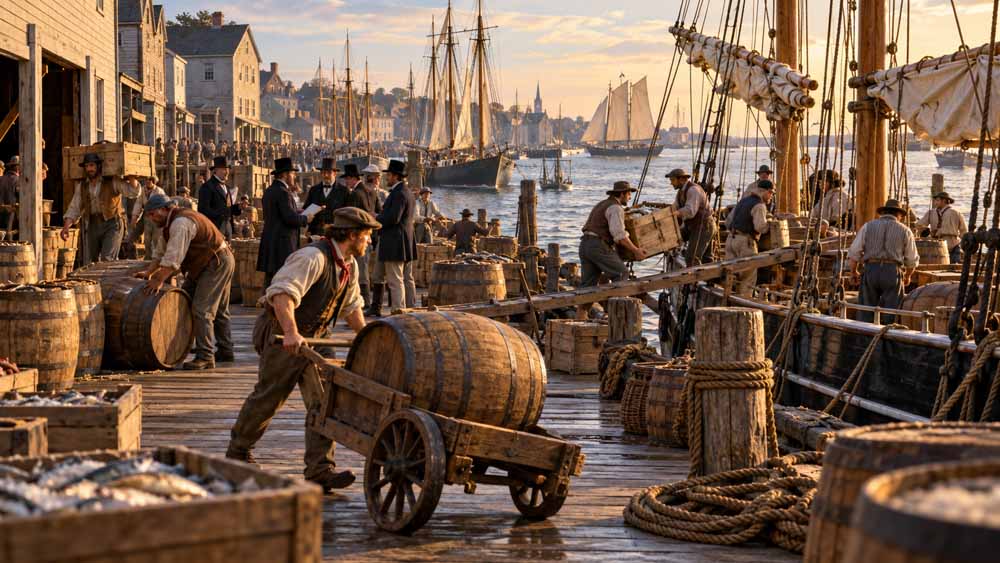
By the end of the 1700s, the schooner had become the most important ship in North America. Schooners carried cargo up and down the Atlantic coast and out to the West Indies, and fleets of them sailed from Gloucester and other New England ports to fish the cod-rich Grand Banks off Newfoundland. European shipwrights took notice, and soon after 1800 they began building schooners of their own.
Speed made schooners valuable in riskier trades, too. Around the Chesapeake Bay, builders developed sharp, fast schooners known as Baltimore clippers, and during the War of 1812 they made formidable privateers, chasing down British merchant ships and outrunning warships. Their lean lines later helped inspire the famous clipper ships.
In 1851, the New York yacht America crossed the Atlantic to race a fleet of British yachts around England’s Isle of Wight, and won. According to a famous story, likely polished over the years, Queen Victoria asked who had come in second and was told, “Ah, Your Majesty, there is no second.” The trophy America brought home was renamed the America’s Cup, still the oldest prize in international sport.
Seventy years later, Canada got a schooner legend of its own. The Bluenose, launched in 1921 in Lunenburg, Nova Scotia, was a working Grand Banks fishing schooner that also beat every challenger in the international fishermen’s races for nearly two decades. She has sailed across the Canadian dime since 1937.
Bigger, Bolder, and the End of an Era
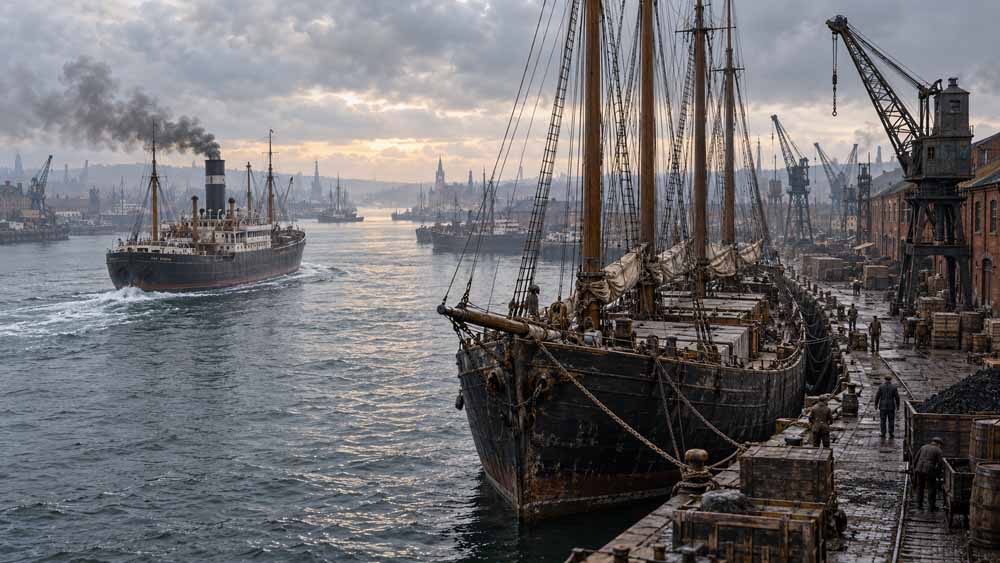
As steamships spread through the late 1800s, schooner owners fought back the only way they could: by building bigger. Three-masted schooners had appeared around 1800, and by the end of the century shipyards were turning out four-, five-, and even six-masted giants to haul coal, lumber, and other bulk cargo. More masts meant more sail without making any single sail too big for a small crew to handle.
The most extreme of them all was the Thomas W. Lawson, launched in Quincy, Massachusetts, in 1902. She was the only seven-masted schooner ever built, a steel-hulled giant nearly 400 feet long carrying about 43,000 square feet of canvas, almost an acre of sail. Steam-powered winches did the heavy lifting, so she sailed with a crew of just 18 where a steamer her size might have needed as many as 50.
Her career was short. In December 1907, battered after an Atlantic crossing, she was caught by a storm in the Isles of Scilly off England’s southwest coast. Her anchor cables parted, she was driven onto the rocks and capsized, and all but two of her crew were lost.
Steam won in the end. Through the early 20th century, steamships and later diesel engines took over the cargo trade, and the great working schooners faded away, though a few held on as fishing vessels for decades longer.
The Schooners That Built Seattle
Seattle’s story begins with a schooner. In November 1851, the schooner Exact left Portland carrying gold prospectors bound for the Queen Charlotte Islands, and her captain agreed to drop a group of settlers on Puget Sound along the way. On November 13, the Denny Party, 10 adults and 12 children, came ashore at Alki Point in pouring rain. One settler later recalled that once their goods were hauled above the tide line, the women sat down on the logs and had a good cry. A monument at Alki still marks the spot where the Exact landed the little colony that became Seattle.
The young town’s first big export was timber for booming San Francisco, and schooners carried it south. Many were built right across the water. The Hall Brothers shipyard at Port Blakely on Bainbridge Island, next to what was once called the world’s largest sawmill under one roof, built most of the schooners in the Pacific Coast lumber trade. In 1896 the yard launched the Inca, the first true five-masted schooner built on the West Coast, which later sailed into San Francisco carrying more than a million board feet of lumber.
The best known of the Northwest schooners was the Wawona, a 165-foot three-master launched in 1897 and the largest of her kind ever built on the West Coast. She hauled Washington lumber to California for 17 years, then sailed out of Anacortes to fish cod in the Bering Sea until 1947, her crew of 36 working handlines from small rowing dories.
Seattle leaders, including Ivar Haglund and Kay Bullitt, bought the Wawona in 1964 to save her as a museum ship, and in 1970 she became the first vessel listed on the National Register of Historic Places. Decades of rot finally put her beyond repair, and she was dismantled at Lake Union in 2009. Her story is one chapter of Seattle’s tall ship history.
So what is a schooner? It’s a ship with fore-and-aft sails on two or more masts, built to sail close to the wind with a small crew. That simple idea carried America’s fishing fleets, won the first America’s Cup, brought Seattle’s founders to Alki, and hauled the lumber that built the West Coast. Most of the great working schooners are gone now, but the style still sails.
You can find it right here on Elliott Bay. Seattle’s Tall Ship schooner Bay Lady is a gaff-rigged schooner built in 1989 in the style of the 19th century, with 2,500 square feet of sail. Guests can help raise those big four-sided sails, take a turn at the helm, and feel the moment the engine goes quiet and the wind takes over.
Sail Elliott Bay on a Seattle’s Tall Ship sailing tour and see a schooner in action for yourself.
Book a sail with Seattle’s Tall Ship
If you have never experienced the thrill of sailing on our tall ship, there is no better time to try than now. With multiple sailing times and experiences available, our family-friendly harbor experiences are a must-do Seattle activity. Join us today!